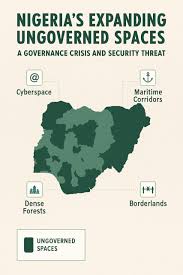
Who Created Nigeria’s Ungoverned Spaces?
By Gwom Ayuba Usman
Nigeria was once a nation where communities were living with security, schools were opening daily, farms were thriving, and highways were connecting people safely. Neighbourhoods were bustling, citizens were trusting in the authority of the state, and families were living without the constant fear of abduction.
Faith communities were coexisting peacefully, and the rule of law was commanding respect. Life, though imperfect, was moving under institutions that were safeguarding citizens.
As Aristotle wisely noted, “Where the law is not supreme, there is no constitution.” At that time, the law was shaping Nigeria’s daily life.
Over time, however, the peace began eroding. Terrorists, bandits, and kidnappers started intensifying attacks, spreading into previously safe areas.
Villages are now facing raids, highways are becoming hunting grounds, and families are living under unrelenting fear. School children are staying home as classrooms are closing under threat, while farmers are abandoning their fields because violence is dictating who can work safely. Armed criminals are controlling territories, extorting villagers, and enforcing rules as though they are the legitimate government, making life miserable for ordinary citizens. Hobbes’ warning is proving true: “In the state of nature, the life of man is solitary, poor, nasty, brutish, and short.” For many Nigerians, this is not a theory; it is becoming a reality.
As insecurity has spread, trust in governance has collapsed. Citizens are beginning to feel as if Nigeria is being governed by two governments: one lawful but distant, and another violent yet present in everyday life. Bandits and terrorists are acting as rulers in forests and villages, imposing rules that citizens cannot resist. Some groups are appearing “more Nigerian” than others, while ordinary people are questioning why protection and justice are unevenly applied. This perception is deepening social divisions, breaking trust between faiths and communities, and is fuelling resentment. As Nnamdi Azikiwe once said, “Nigeria shall not be destroyed by any external force, but may fall by the inaction and complacency of her citizens.”
The consequences are devastating. Families are sinking into poverty as ransom payments are consuming livelihoods. Communities are losing faith in government. Security forces, overwhelmed by the scale and sophistication of criminal networks, are struggling to respond. Citizens are living in a state where survival depends on negotiating with criminals rather than relying on the state. Chief Obafemi Awolowo warned that “It is the duty of every citizen to contribute to the progress and security of the nation.” Today, this duty is being ignored, and the ungoverned spaces are flourishing.
Who created these ungoverned spaces? They were created by the violent acts of criminals, compounded by governance failures, corruption that weakened early interventions, and citizen disengagement that allowed criminality to flourish. Terror, neglect, and silence have combined to transform once-secure communities into landscapes of fear and despair.
Responsible citizenship has never mattered more. Citizens must be reclaiming their voice, communities must be rebuilding trust, and leaders must be acting decisively, honestly, and fairly. As Ahmadu Bello emphasised, “Nigeria belongs to all of us, and each of us must protect it.” The survival of Nigeria depends on engagement, not apathy.
The nation is standing at a pivotal moment: the future depends on whether citizens are choosing responsibility, whether communities are acting in unity, and whether leaders are rising to restore what violence and neglect have destroyed. If responsible citizenship is revived, Nigeria can reclaim its ungoverned spaces; if not, these territories will continue defining the nation’s future.
Gwom writes from the Gombe State Directorate of the National Orientation Agency (NOA). He is also the current Secretary General of, Ibaas-Foron Development Organisation (IFDO).

 20
20




1 comment