Two Nigerians Are Heading To 2027 – Report

Our Staff Reporter
Four months ago, the story of Nigeria’s next election looked simply, at least in polling terms. The opposition appeared to be surging. The government appeared deeply unpopular. If enough people turned out to vote, the result seemed almost settled.
Today, that story no longer holds, at least according to new survey data.
According to the second wave of SBM Intelligence’s Voter Sentiment Tracker, the race has narrowed sharply.
The report puts the Nigeria Democratic Congress (NDC) at 42.2% against 25.5% for the ruling All Progressives Congress (APC), a lead of 16.7 points, down from a 46-point gap recorded in its May wave.
It is still a lead, on the basis of this survey. It is no longer a landslide. And beneath that headline number is a more complicated picture: less anger than in May, according to respondents, but not satisfaction.
More optimism about the economy in some areas, but continued concern about security.
And an increasingly split electorate not just by region or party, but by where people live, how they get their news, and what they worry about most.
The survey, conducted among 1,103 voters across 12 states and the Federal Capital Territory and concluded on September 8, 2026, does not predict who will win in 2027. What it does is describe a shift in stated sentiment among those interviewed.
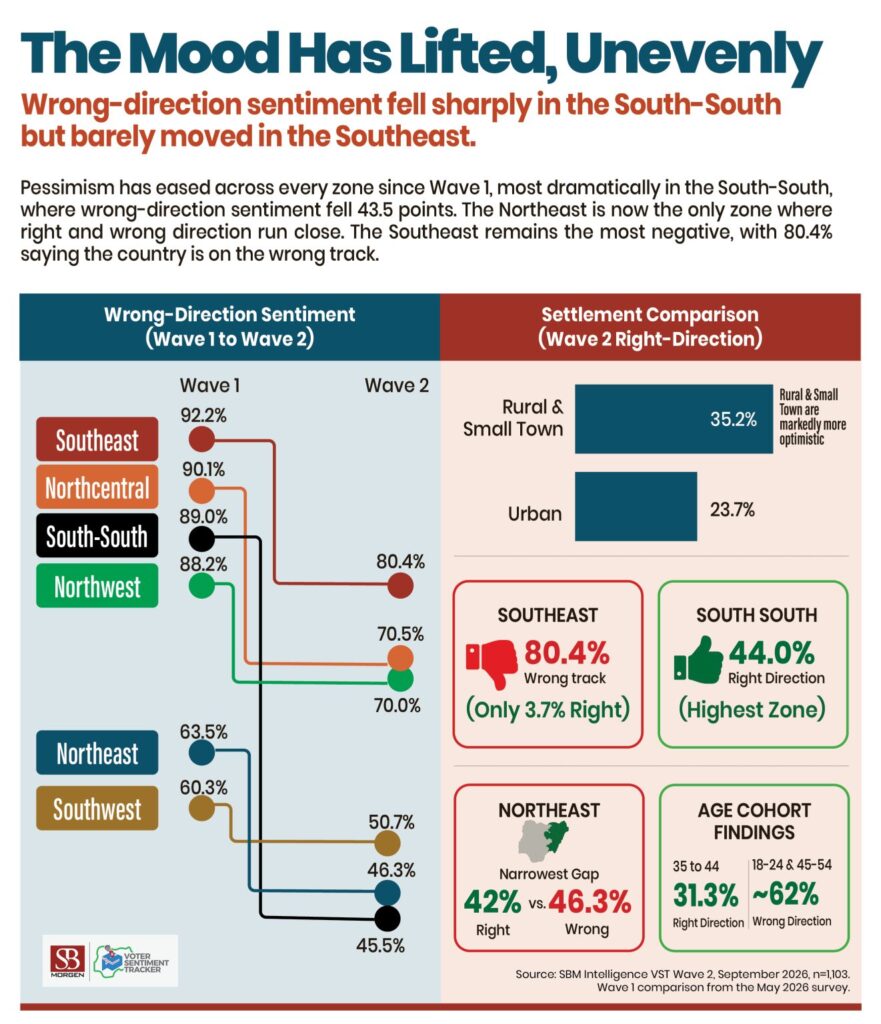
In May, 79.5% of respondents said the country was moving in the wrong direction.
In September, that figure had fallen to 56.8% in the survey. Every zone recorded an improvement, most notably the South-South, where wrong-direction sentiment fell by 43.5 points, according to SBM.
President Bola Tinubu’s standing also moved in the survey. His net favourability rose from -58.5 to -3.3, still negative, but no longer at the level recorded in May. The report links the change to easing inflation, a stronger naira, pump prices retreating from their May peak, and GDP growth of 4.43% in the second quarter.
Yet the recovery, as measured by SBM, is not evenly spread. It is a map of contrasts. Tinubu is rated +49.8 in the Southwest and +45.9 in the South-South, but -67 in the North Central and -75.7 in the Southeast.
Peter Obi, still the strongest national figure in the survey at +52.8, is rated +98.1 in the Southeast but negative in the Northwest.
Rabiu Kwankwaso, close to neutral nationally in the survey, is rated +56 in his Northwest base and negative in most other zones.
Nigeria, in other words, does not have a single frontrunner with broad national appeal in this data. It has figures with strong regional support.
That fragmentation is visible on the electoral map presented in the report. The NDC leads in the Southeast at 84.1% and the North Central at 62.5%, according to the survey.
The APC leads in the Southwest and the South-South. The Northeast is split four ways, with Labour ahead at 25.9%, followed by the ADC, the NDC and the APC.
But the deepest divide in the survey is not between zones. It is between town and country. Urban respondents back the NDC by 49.5% to 20.9%. Rural and small-town respondents back the APC by 35.2% to 27.6%.
Urban respondents rate Tinubu at -16.4. Rural respondents rate him at +22.5, a 39-point gap in the survey. They do not just vote differently in the data, they also report different information habits.
About 61.1% of urban respondents said they rely on social media for news, compared to 29.6% of rural respondents. Radio was reported as more important in the countryside.
Trust in the electoral commission splits the same way in the survey: 58.3% of urban respondents said they are not confident in the Independent National Electoral Commission (INEC), against 29.6% of rural respondents.
Even their stated worries differ, as urban respondents named insecurity first while rural respondents named petrol first, and petrol has become the surprise issue of this survey cycle. It was not offered as an option in May, but in September, it is the second-most cited national problem in the survey, the government’s worst-rated issue, and the leading concern in both the Southwest and the South-South.
Two-thirds of respondents favoured some form of subsidy return, 38% favoured full reinstatement, and 29.4% favoured a targeted subsidy for the poor. The report describes it as unclaimed political ground: a middle position that, in its view, no campaign has yet adopted.
Insecurity remains the top national concern among respondents, and the government’s handling of it is still rated poorly in the survey. Only 9% rated it as good or very good.
The reported abduction of worshippers in Borgu in August, as referenced in the report, split respondents: 44.8% said it made them less confident in the government’s ability to protect citizens, while 34.4% said the president’s reported response made them more confident.
Perhaps the most consequential change in the survey is about turnout itself. In May, SBM found that high turnout favoured the opposition.
In September, that pattern has reversed in its modelling.
The NDC does slightly better when turnout is low, because widening the electorate pulls in more voters from the Southwest and Northwest — the zones that, in the survey, have swung toward the incumbent.
Mobilisation, the report argues, no longer solves the opposition’s problem. Its problem, in SBM’s assessment, is geography. There is one group that could still change the picture, and it is currently less engaged. Voters aged 18 to 24 recorded the lowest turnout intent, the highest share without a voter card at 18.2%, and the most negative view of the incumbent of any age group in the survey.
They appear anti-incumbent in the data without yet being aligned to a particular alternative, and many are not currently positioned to vote. SBM describes it as a registration challenge before it is a persuasion challenge.
Confidence in INEC has improved overall in the survey, from 66.3% not confident in May to 48.9% now, helped in part, according to SBM, by perceptions of the Osun governorship election in August.
But the improvement has not reached the Southeast and North Central, the two opposition-leaning zones where scepticism remains highest in the data.
On policy, respondents were clearer than the political debate often suggests. State police is backed by 70.6% of respondents in the survey, the strongest mandate recorded, with only the Northeast dissenting.
On subsidy, on security, on policing, respondents in the survey are not asking for slogans. They are asking for results. That is the country SBM describes: less angry, more divided, and harder to win with a single message.
The NDC remains the party to beat in this survey. The APC has recovered, but unevenly. The opposition is split across two platforms, and 40.9% of respondents believe that split weakens it. What happens next will not be decided by national averages alone.
In SBM’s data, it will be decided in the Southwest and Northwest, in rural towns and urban centres, among young voters who have not yet registered, and among older voters who are still undecided.
Two Nigerians are heading to 2027. The campaign that learns to speak to both may be the one that wins.
This story is based on a report of SBM Intelligence’s published findings. It does not endorse any candidate or party and does not predict the outcome of the 2027 general election.

 20







Post Comment