OPERATION SAFE CORRIDOR OR SAFE IMPUNITY? NIGERIA’S DANGEROUS SHORTCUT TO PEACE
By Jonathan Ishaku
Nigeria’s counterterrorism policy is increasingly defined by a contradiction it refuses to acknowledge.
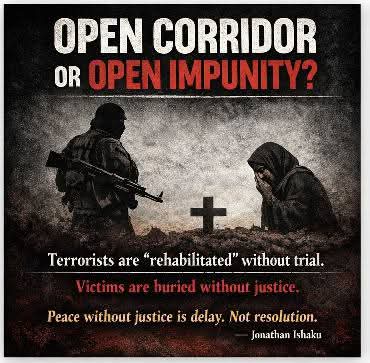
On one side, civilians continue to die under the fog of war—misidentified, unprotected, and often without accountability. On the other hand, individuals who took up arms against the state are quietly processed through Operation Safe Corridor and returned to society—without transparent trials, without public scrutiny, and often without justice for victims. This is not balanced. It is policy incoherence.
The fundamental flaw of the Safe Corridor approach is simple: it attempts to replace justice with rehabilitation, rather than sequencing rehabilitation after justice. Terrorism is not a social misstep like drunkenness, sexual promiscuity or bullying, which can be cured through spiritual deliverance or counselling; it is a criminal enterprise involving mass murder, abduction, and organised systemic violence. To treat perpetrators of terrorism primarily (mark that word) as candidates for reintegration—without judicial determination of guilt—is to reduce grave crimes to administrative inconvenience. A state that does this sends a dangerous signal: violence is negotiable.
The defenders of the policy often invoke humanitarian logic: they are our brothers, our children—”the Biblical prodigal sons”. But human rights without due process is not justice—it is discretion, a dangerous discretion. Who determines that a surrendered fighter is “low risk”? What evidence is used? Where is the voice of the victim, the innocent, law-abiding citizens? And what mechanism exists to hold the system accountable if a reintegrated individual returns to violence? These are not abstract questions. They go to the heart of state legitimacy.
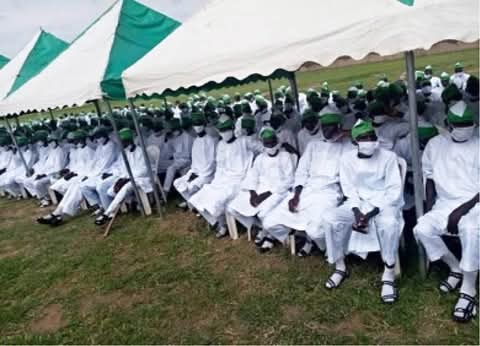
Even more troubling is the strategic contradiction embedded in the policy. Counterterrorism is about shaping incentives. When terrorist fighters observe that continued resistance leads to death, but surrender leads to rehabilitation and reintegration with material benefits, the moral boundary between punishment and reward becomes blurred. The result is not deterrence—for the combatant terrorist, it is survival cum recalibration in the name of rehabilitation!
Communities understand this instinctively. Across the North East and other conflict-affected regions, there is growing unease about the reintegration programmes imposed without transparency or local consent. For communities that have buried their dead, the return of perpetrators without trial is not reconciliation—it is enforced amnesia. And amnesia is not peace.
(Read Jecyqhatong Yakubu Pinta’s untitled parody in her Facebook post yesterday)
The greatest casualty of this policy is moral clarity. When victims remain displaced, uncompensated, and unheard, while perpetrators are processed, trained, clothed, celebrated and reintegrated by the government, the state risks appearing to invert justice—rewarding violence while neglecting suffering. No counterinsurgency survives that perception.
Rehabilitation is not wrong. Indeed, it is necessary. But it must follow justice, not replace it. A credible framework must be anchored on three principles: transparent prosecution, victim-centred justice, and post-sentencing rehabilitation. Anything less is not peace-building. It is a postponement.
Nigeria cannot defeat terrorism by diluting justice. And it cannot build peace on a foundation of victim silence.
A Safe Corridor that bypasses justice is not a pathway to peace—it is a corridor to impunity, and more violence.

 20
20












Post Comment